ML for Genre Clustering and Popularity Forecasting from Spotify Charts
Using Spotify's Top 200 chart data, this project grouped songs by their audio profile, predicted which songs become hits, and forecast which artists would dominate the charts in 2024, comparing classic time-series models with gradient-boosting methods.
7,700+
songs clustered by audio features
0.89
F1-score for hit prediction
4
forecasting models compared
Pipeline
01
Data
Spotify Top 200 chart history with audio features for each song
02
Features
Preprocessing, feature engineering and PCA
03
Cluster
K-Means and GMM group songs by audio profile
04
Classify
Random forest, decision tree and logistic regression predict hits
05
Forecast
ARIMA, Prophet, XGBoost and LightGBM predict 2024's top artists
Clustering songs
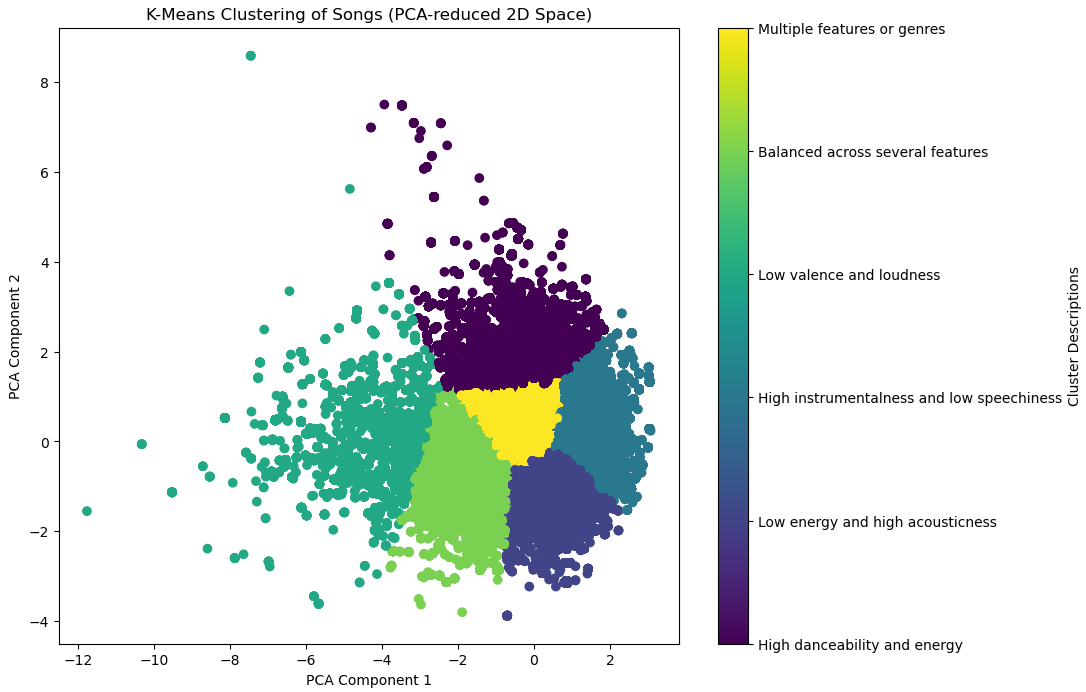
Audio features such as danceability, energy, acousticness and valence were reduced with PCA and clustered, producing groups with clear musical identities, for example high-danceability, high-energy tracks versus low-energy acoustic ones.
Predicting hits
Engineered features fed several classifiers to predict hit songs and popular artists, evaluated with accuracy, precision, recall and F1-score using five-fold cross-validation. The best model reached an F1-score of 0.89.
Forecasting 2024
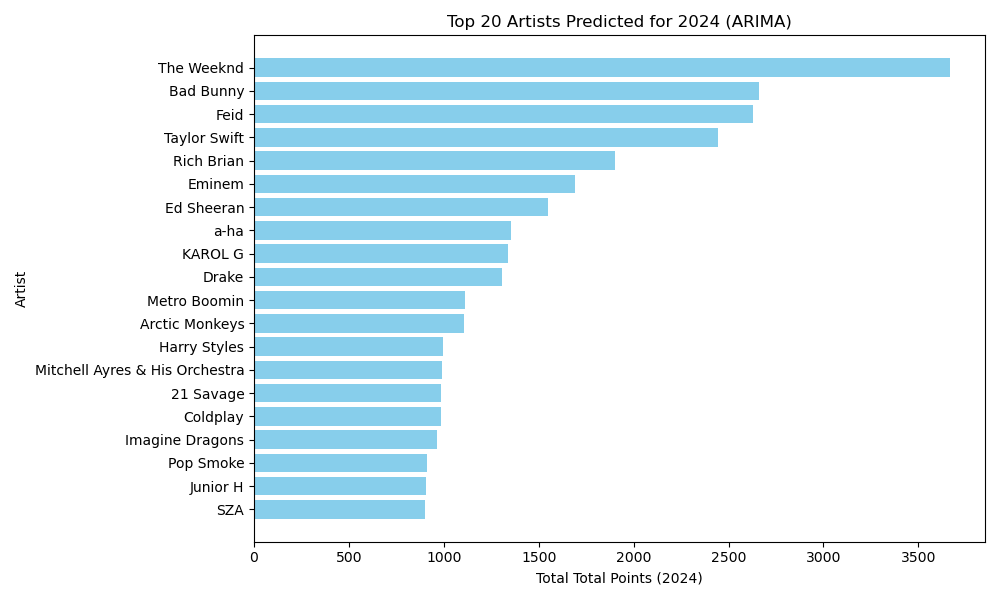
Each artist's chart points over time were treated as a time series. ARIMA and Prophet were compared with per-artist XGBoost and LightGBM regressors, both on daily points and on monthly appearances, to forecast the most popular artists of 2024.