Privacy for Hire: MSc Dissertation
Privacy tools only work if someone runs the servers. This dissertation compares three ways of paying for that infrastructure (volunteers in Tor, token rewards in Nym and subscriptions in commercial VPNs) and asks what each one does to the sustainability, decentralisation and privacy of the network.
3
systems compared: Tor, Nym and commercial VPNs
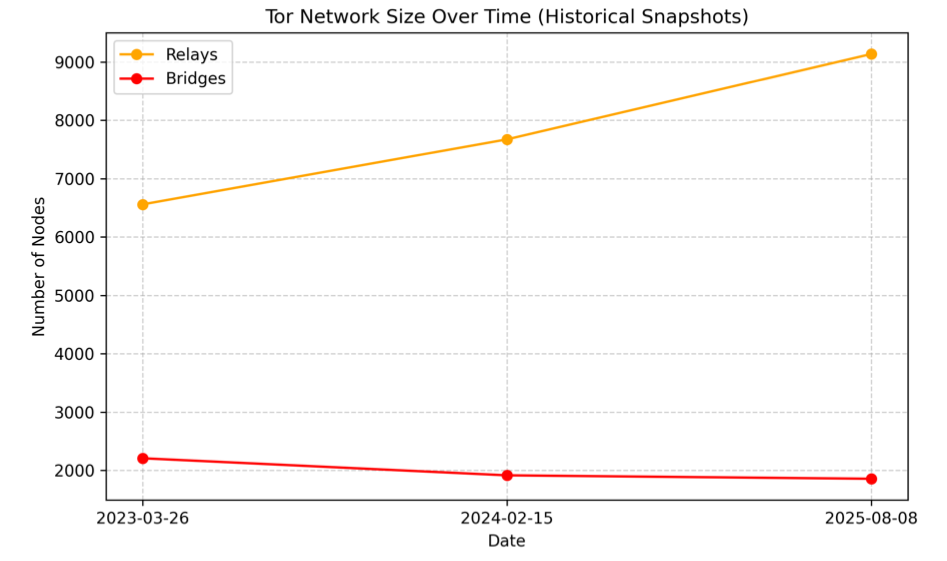
6,600 → 9,100
Tor relays, March 2023 to August 2025
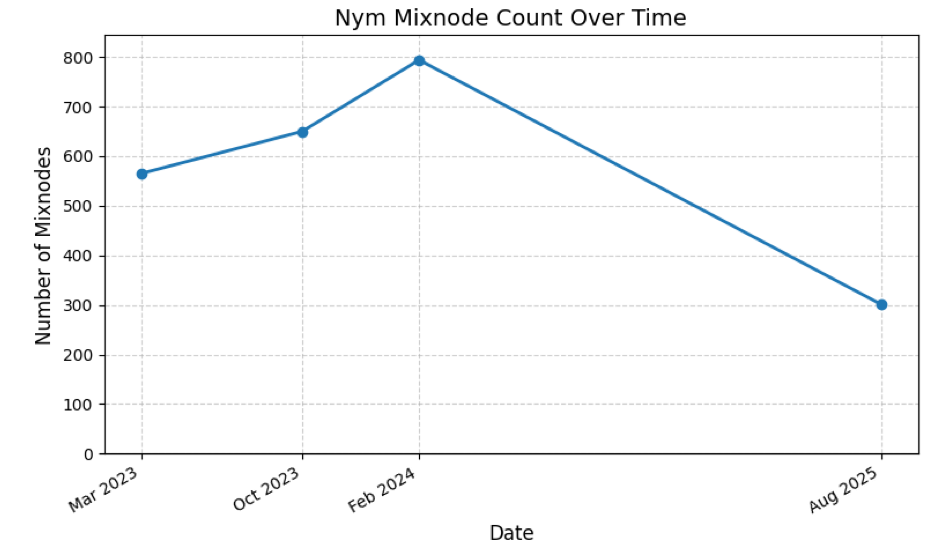
794 → 301
Nym mixnodes, early 2024 peak to August 2025
77
countries hosting Tor relays in August 2025
Research approach
01
Model
A game-theoretic model of operator incentives: rewards, costs, detection and penalties
02
Scenarios
Stress-test each system under token devaluation, legal crackdowns and infrastructure clustering
03
Data
Time-aligned 2023–2025 snapshots from Tor Metrics and the Nym explorer, plus VPN provider reports
04
Compare
Privacy guarantees, incentive sustainability, scalability and operator diversity
The question
Tor relies on volunteers who run relays for ideological reasons. Nym pays operators in tokens and penalises poor performance. Commercial VPNs are run by companies funded by subscriptions. Each model changes who runs the infrastructure, how many independent operators there are, and how hard it is for an adversary to control the network, which directly affects how private its users really are.
The model
Each operator is modelled by the payoff of behaving honestly, which shows when contributing stays rational and when leaving or free-riding becomes the better choice. The model is used to reason about enforcement and when each system settles into a stable equilibrium.
Nym operator
r − c > −p · f
Keeps contributing while rewards minus costs beat the expected penalty for misbehaving.
- r
- token reward
- c
- operating cost
- p
- chance of being caught
- f
- penalty (slashing)
Tor volunteer
u − c > 0
Keeps running a relay while its personal, non-monetary value outweighs the cost.
- u
- ideological or social value
- c
- operating cost
Attacker
a = α(d, c, r)
The cost of compromising the network rises with the diversity of its operators.
- a
- cost to compromise
- d
- operator diversity
- c, r
- operator cost and reward
What the data showed
- ▸Tor grew slowly but steadily, from about 6,600 relays in March 2023 to over 9,100 in August 2025 across 77 countries. Bridges, which help users get around censorship, fell from about 2,200 to 1,850 over the same period.
- ▸Nym grew to almost 800 mixnodes in early 2024, then contracted to 301 by August 2025, in line with token-market conditions. Active nodes stayed reliable, with a median uptime of 95–98%, and the network still spans 74 countries.
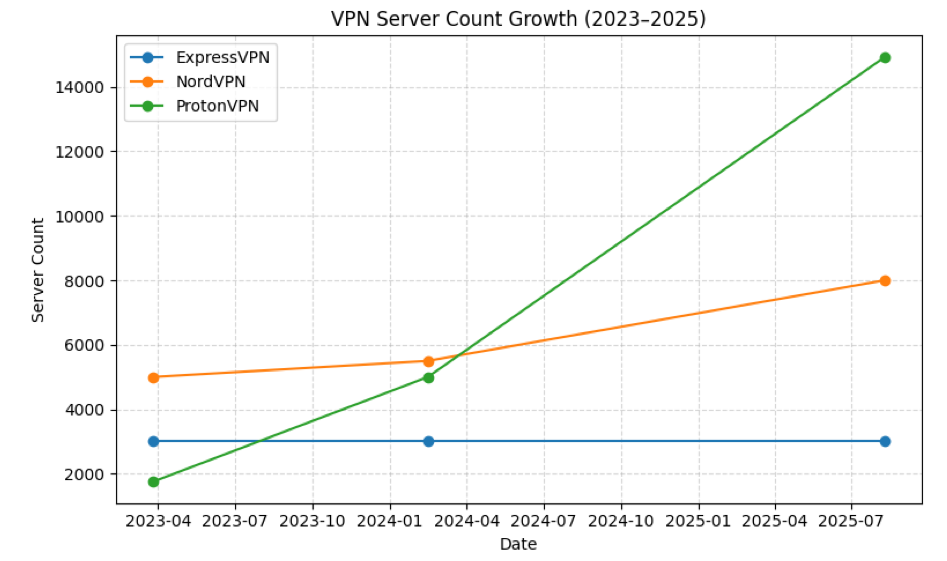
- ▸Commercial VPNs scaled fast through investment (ProtonVPN went from 1,750 to 14,930 servers; NordVPN from about 5,000 to over 8,000), but more servers do not make users more anonymous, and ownership is concentrated: one company owns ExpressVPN, CyberGhost, Private Internet Access and ZenMate.
Key findings
- ▸Operator diversity is a security property, not a nice-to-have: less diversity means a smaller anonymity set and makes traffic correlation and Sybil attacks easier
- ▸Tor has the most diverse operators but is the most exposed to volunteers dropping out under legal or financial pressure
- ▸Nym's staking and slashing enforce good performance, but participation is sensitive to token prices, and staking thresholds can push out smaller operators
- ▸VPNs are reliable and easy to scale, but a single legal order or compromise at the provider can expose every user
- ▸Hybrid incentive designs, combining economic rewards with reputation, subsidised participation and low barriers to entry, are the most promising way to keep a large and diverse set of operators
Limitations and next steps
The model uses symbolic rather than empirically calibrated parameters and treats strategies as fixed, and VPN data relied on provider disclosures rather than continuous measurement. Future work would calibrate the model with real operational data, add adaptive multi-agent behaviour, and simulate hybrid incentive schemes.